
Whistleblowing Policy
-
1Table of Contents1. Introduction
2. Scope of Policy
3. Safeguards
4. Procedures for Making a Disclosure
5. Timescales
6. Record Keeping
7. WhistleblowingAppendix 1 – Whistleblowing Procedure
1. Introduction
An important aspect of accountability and transparency is a mechanism to enable staff and other members of Innovate Dorset Ltd. to voice concerns in a responsible and effective manner.
It is a fundamental term of every contract of employment that an employee will faithfully serve their employer and not disclose confidential information about the employer’s affairs. Nevertheless, where an individual discovers information that they believe shows serious malpractice or wrongdoing within Innovate Dorset Ltd., then this information must be disclosed internally without fear of reprisal, and there should be arrangements to enable this to be done independently of line management.
The Public Interest Disclosure Act, which came into effect in 1999, gives legal protection to employees against being dismissed or penalised by their employers as a result of publicly disclosing certain serious concerns. Innovate Dorset Ltd. endorsed the provisions set out in this document to ensure that no members of staff should feel at a disadvantage in raising legitimate concerns.
This Policy is intended to assist individuals who believe they have discovered malpractice or impropriety. It is not designed to question financial or business decisions taken by the Company Director or Innovate Dorset Ltd., nor should it be used to reconsider any matters that have already been addressed under harassment, complaint, disciplinary or other procedures. Once the “whistleblowing” procedures are in place, it is reasonable to expect staff to use them rather than air their complaints outside Innovate Dorset Ltd.
This Policy is to be used alongside the Allegations Policy.
2. Scope of Policy
This Policy is to inform employees of the Company procedure to raise concerns internally at a high level and disclose information that the individual believes shows malpractice or impropriety. This Policy is intended to cover concerns that are in the public interest and may at least initially be investigated separately, but which might then lead to the invocation of other procedures, e.g. disciplinary.
These concerns could include:
- Financial malpractice, impropriety or fraud.
- Failure to comply with a legal obligation or statutes.
- Dangers to Health and Safety or the environment.
- Criminal activity.
- Improper conduct or unethical behaviour.
- Safeguarding concerns.
Attempts to conceal any of the above.
When to Use this Policy
There is a difference between Whistleblowing and raising a grievance:- Whistleblowing applies where an individual has a concern about a danger, wrongdoing or illegality that has a public interest aspect to it - for example, because it threatens service users, third parties or the public generally.
- A grievance is a complaint that generally relates to an individual's own employment position or personal circumstances at work.
This Policy does not set out the procedure that applies to general grievances. If you have a complaint about your own personal circumstances, you should use the Company's Grievance procedure as detailed in the Employees Handbook.3. Safeguards
Protection
This Policy will offer protection to those employees of the Company who disclose such concerns, provided the disclosure is made in good faith and, in the reasonable belief of the individual making the disclosure, that they intend to show malpractice or impropriety, and if they make the disclosure to the appropriate person:
Company Director,
If concerns regard the Company Director, these should be raised with a member of the Senior Leadership Team.
Kevin Tatchell,
k.tatchell@innovatedorset.co.uk.It is important to note that no protection from internal disciplinary procedures is offered to those who choose not to use the procedure. In an extreme case, malicious or wild allegations could give rise to legal action on the part of the persons complained about.
Confidentiality
The Company will treat all such disclosures in a confidential and sensitive manner. The identity of the individual making the allegation may be kept confidential, so long as it does not hinder or frustrate any investigation. However, the investigation process may reveal the source of the information and the individual making the disclosure may need to provide a statement to the Police as part of the evidence required.
Anonymous Allegations
This Policy encourages individuals to put their name on any disclosures they make. Concerns expressed anonymously are excepted at discretion, but may be harder to investigate fully. In exercising this discretion, the factors to be considered will include:
- The seriousness of the issues raised
- The credibility of the concern
The likelihood of confirming the allegation from attributable sources.
Untrue Allegations
If an individual makes an allegation in good faith, which is not confirmed by subsequent investigation, no action will be taken against that individual.
In making a disclosure, the individual should exercise due care to ensure the accuracy of the information. If, however, an individual makes malicious or vexatious allegations, and particularly if they persist in making them, disciplinary action may be taken against that individual.
4. Procedures for Making a Disclosure
On receipt of a complaint of malpractice, the member of staff who receives and takes note of the complaint must pass this information as soon as is reasonably possible to the appropriate designated investigating officer as follows:
The Company Director will investigate malpractice complaints, unless the complaint is against the Company Director or is related to the Company Director’s actions. In such cases, complaints against the Company Director should be passed to a nominated appropriate investigating officer appointed by the Company Director.
The Company Director may appoint a person of senior management to investigate complaints on their behalf.
If there is evidence of criminal activity, the investigating officer should inform the Police. The Company Director and Management will ensure that any internal investigation does not hinder a formal Police investigation.
5. Timescales
Due to the varied nature of these complaints, which may involve internal investigators and/or the Police, or LADO, it is impossible to lay down precise timescales for such investigations. The investigating officer should ensure that the investigations are undertaken as quickly as possible without affecting the quality and depth of those investigations.
As soon as practically possible, the investigating officer should send a written acknowledgement of the concern to the complainant; thereafter, they should report back to them in writing the outcome of the investigation and the proposed action.
If the investigation is a prolonged one, the investigating officer should keep the complainant informed, in writing, as to the progress of the investigation and as to when it is likely to be concluded.
All responses to the complainant should be in writing.
The complainant will be informed of the outcome of the investigation as far as confidentiality allows
6. Record Keeping
All notes, documents that were taken, or evidence from the plaintiff about any malpractice or impropriety will be kept in line with the Company’s Record Keeping Procedures.
7. Whistleblowing
All staff are made aware of the Company’s Whistleblowing Policy at the time of Induction and encouraged to voice concerns about the attitude or actions of colleagues.
If a staff member believes that a reported allegation or concern is not being dealt with appropriately by Management, they should report the matter to the LADO.
LADO Dorset County Council:
01305 221122. Referral – Management of Allegations against people who work with children (Dorset)
LADO BCP Council:
01202 456744/221122. Referral – Town Hall, Bournemouth, Dorset BH26DY
It is in the Company interest for cases to be dealt with expeditiously, fairly, and thoroughly and for unnecessary delays to be avoided.
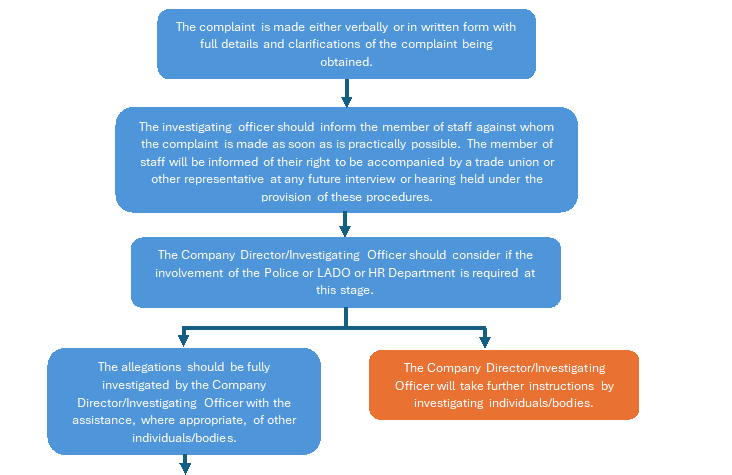
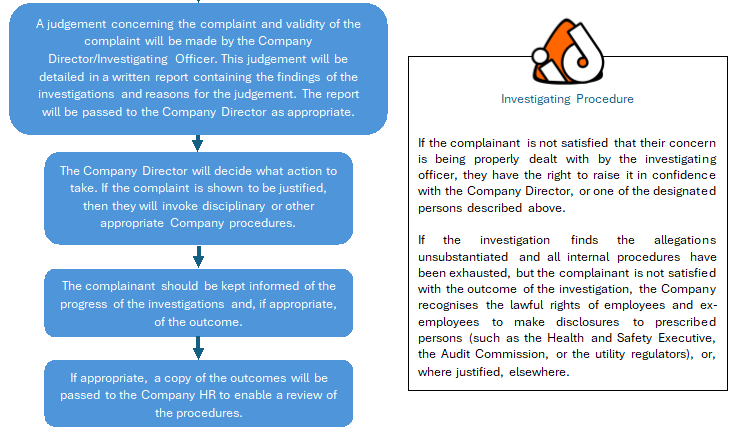
Appendix 1 – Whistleblowing Procedure

CONTROL SHEET
Version Number: 2
Author: Kevin Tatchell
Whistleblowing Policy
Status of policy: Approved Approved by: Kevin Tatchell Date of Review: 23 January 2026 Reviewed by: HRDept 
Next Review Date: 23 January 2027